Plugs into your course manual
AlphaForge slots into the modules you already teach. You keep your curriculum; we add the AI craft on top of it.
A student who leans on AI before mastering the fundamentals cannot catch it when it is confidently wrong. AlphaForge plugs into your course manual, helps your professors adapt, and gives every student a private, encrypted study brain that lives on their own device, so your graduates leave able to direct AI and defend the result, not just generate it.
Created by a Maastricht University finance lecturer and an RSM M&A practitioner.

Every faculty knows AI will define how this generation works. The will to prepare students for it is not the gap. Where to start is.
The tools change monthly. Faculty are asked to teach something that did not exist last term, with no clear place to begin, while students already use AI in the dark, often without the judgment to catch where it is confidently wrong.
Graduates who cannot defend AI-assisted work carry your reputation into every interview and every desk.
Professors lose hours inventing AI guidance for tools that changed last month, instead of teaching their field.
With no shared standard, AI policy is set ad hoc, course by course, inconsistently, and often not at all.
Without fundamentals first, students lean on AI before they can catch it, the competency collapse a university exists to prevent.
AlphaForge teaches students to handle and integrate AI in their field, fundamentals first and AI on top. It does not compete with your degree. It strengthens it.
AlphaForge slots into the modules you already teach. You keep your curriculum; we add the AI craft on top of it.
We co-design with faculty and support them to adapt their own material, in collaboration, never by replacing them.
Fundamentals before AI, documented answers, weaknesses surfaced early. The whole method is the antidote to faking competence.
Start with finance, then extend to Law and beyond. A student's brain pulls knowledge across disciplines, so understanding compounds.
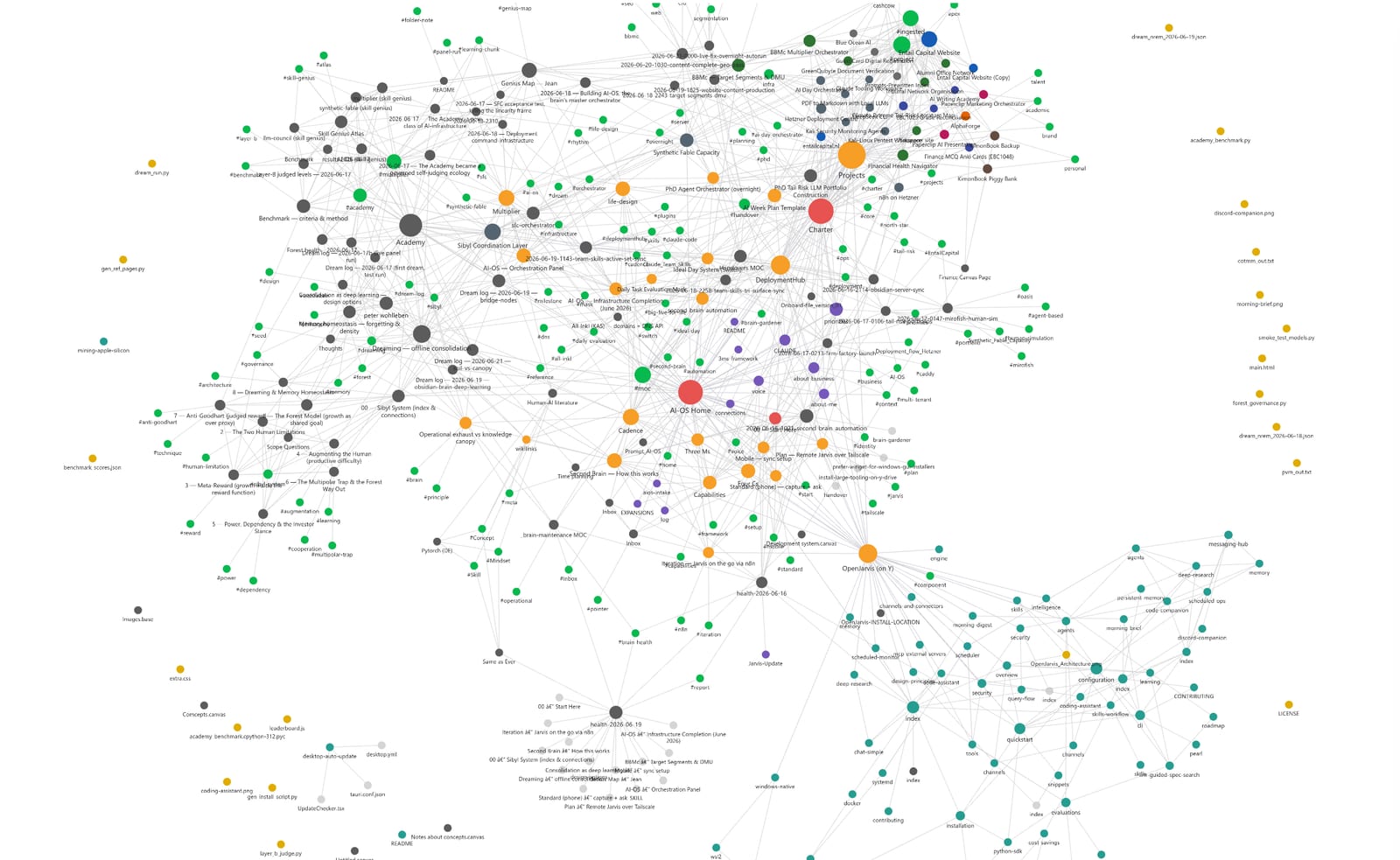
Each student gets an Obsidian second brain: an encrypted, local-first knowledge network they own.
Each student gets an Obsidian second brain that lives on their own machine, encrypted. The network never sees who they are.
Only the student's own laptop can see their name and know the notes belong to them. There is no central store of who learned what.
Students surface and work their own gaps instead of cramming, which is exactly how grades move.
In aggregate and fully anonymised, the brains show the university where a cohort has knowledge gaps, so you can act, without ever identifying a student.
The brain keeps an opt-in, continuous connection with your students after they leave. Offer alumni meaningful courses as their field keeps shifting, and stay the institution that keeps making them better, for the length of a career, not a semester.
Bring these to the call. They are the conversation we want to have with you.
How do your students learn to use AI in their discipline today, and who actually owns that?
Where do your faculty struggle to keep pace, and where might students already be leaning on AI without the judgment to catch it?
If graduates leave without verifiable, responsible AI skill, what does that cost your reputation, your rankings, and their employability?
What would it be worth to give every student a private AI brain and your faculty a ready-to-adapt curriculum, co-designed with you, this year?
AlphaForge is built by a Maastricht University finance lecturer and an RSM M&A practitioner, on a hard line: AI is a force-multiplier on real understanding, never a shortcut around it. We are selecting a small number of launch university partners to co-design this with, in the open.
Sources: Knowledge / AI Capability Assessment 2026
No. The brain is local-first and encrypted; only the student's own device sees their identity. Anything the institution sees is aggregated and anonymised, never per-student.
Yes, by design. Student-identifiable data stays on the student's device. We never hold a student-identified store, and we put the data-processing specifics in writing before anything starts.
The opposite. We adapt to your course manual and support your professors to integrate AI, so they stop improvising guidance for tools that keep changing.
No. We are a layer on top. You keep your courses and your standards; we add the AI craft and the proof that students can defend their work.
Certificates are platform-issued and portfolio-backed. We make no external-accreditation claim; they complement your degree, they do not stand in for it.
A single module or a first cohort. We co-design it, you evaluate the result, then you decide. Launch partners help shape the roadmap and get founder terms.
We are choosing a few partners to build this with as a design canvas, with a real say in the roadmap. No cost to explore. You leave the call with a concrete plan for your faculty, whether or not we work together.